
Estimated reading time: 8 minutes
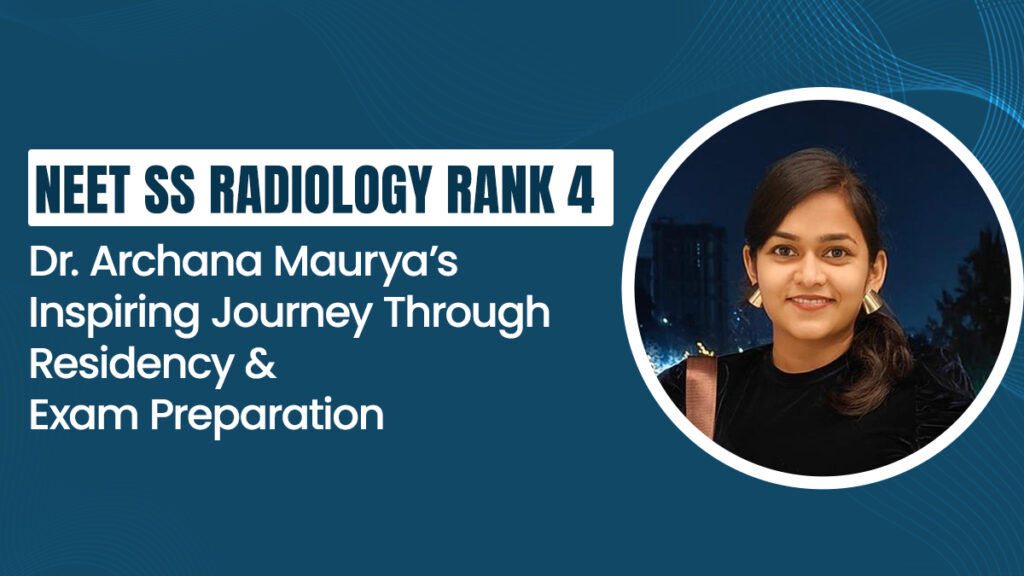
You know Dr. Archana Maurya has secured a top rank in NEET SS Radiology which is no small feat, especially in an exam that tests your years of clinical exposure, conceptual clarity, and calm decision-making. Dr. Archana Maurya, who achieved this milestone All India Rank 4, shares a wholesome journey that perfectly relatable deeply with every radiology resident, filled with self-doubt, learning curves, and steady growth.
In this candid conversation with Dr. Zainab Vora, Dr. Archana has opens up about her overall residency experience, about preparation strategy, challenges with physics, and what truly matters for success in NEET SS.
Background and Academic Journey
Dr. Archana Maurya has completed her MBBS from a Government Medical College, Meerut, which has been followed by DNB Radiodiagnosis from Jehangir Hospital, Pune. After that she thoroughly completed her residency program in November 2025 and then she has appeared for the NEET SS examination in December 2025, while securing a remarkable Rank 4 in it.
Her involvement in radiology existed even before she joined postgraduate training. Though, like many residents, the strength of daily work often pushed long-term exam goals to the background.
Residency Reality: Radiology Is Not “Easy”
You know that one of the most reassuring aspects of Dr. Archana’s journey? is her honest explanation of radiology residency.
in spite of common perceptions, radiology residency does not always come with instant work-life balance. It comes with intense workload, the reporting part is continuous, and learning is relentless. While it may be marginally less physically demanding than some clinical branches, the mental load is equally heavy.
The Overwhelming First Year
The first year of radiology residency can be particularly terrifying. Dr. Archana recalls feeling completely lost initially, unable to differentiate findings that seniors identified effortlessly.
This phase, she explains, is universal.
“In the first few months, everything looks the same. You don’t understand how seniors see what they see. But slowly, your eyes adapt.”
With continuous case exposure, reporting, and discussion, the brain begins to recognize patterns. Over time, radiology has finally transformed from confusion into fascination.
This proper reassurance is invaluable for the junior residents who are questioning their choices early in training.
Learning Through Cases, Not Just Books
Rather than just depending upon on isolated exam preparation, Dr. Archana was learning deeply into daily clinical work.
She developed a powerful habit:
- After reporting a case, she would search for 10–15 similar images
- As she used to study different imaging appearances of the same pathology
- She used to read differential diagnoses for each case
This approach has allowed her to learn those multiple conditions through a single case, which helps to strengthen both conceptual understanding and image recognition.
This method became the core foundation of her NEET SS readiness, even before she consciously started preparing for the exam.
When Did NEET SS Preparation Actually Begin?
Like many residents, Dr. Archana did not begin dedicated NEET SS preparation early in residency. The focus was on learning the job, reporting cases, and surviving duties.
It was only after receiving her DNB practical exam results that she became more exam focused. By then, she had already built a very strong conceptual base for herself through consistent and case-based learning.
Struggles with Standard Textbooks
Dr. Archana has openly discussed that fear with many residents; she shares: the standard textbooks can sometimes feel overwhelming, especially in the first year.
despite the advice from seniors to “read those standard books from Day 1,” which helps to balance the exhaustive textbooks with all the clinical duties which felt unrealistic.
Although after that by the end of her first year, she felt very anxious and unconnected, and had read a lot but maintained little.
Finding Structure Through Conceptual Learning
There will be a turning point that comes in the second year when the structured concept-based learning resources become available.
What worked for her was:
- The explanation were very concise
- combination of standard textbook content
- Incorporation of recent literature
- Time efficiency
Instead of spending multiple hours in multiple sources, she could just understand a topic perfectly in one focused session.
However, in the middle of her third year, she completed nearly 70–80% of her structured conceptual learning, which finally giving her confidence before her theory exams.
Tackling the Biggest Fear: Physics
Physics is often the most dreaded subject in radiology, and Dr. Archana’s reaction was no different.
She recalls opening a physics chapter during her first-year X-ray posting and momentarily questioning her career choice.
What made the difference was good teaching.
When physics concepts have been explained with:
- The utmost logical flow
- Clinical applicability
- Perfect visual representation
The subject became manageable and even interesting.
Her biggest takeaway?
“Physics cannot be skipped. And it cannot be read once.”
Physics requires multiple revisions, especially close to the exam, because it is easy to forget if not reinforced.
DNB Exit Exam Preparation: Theory and Practical
Theory Exams
For theory, the focus was on:
- Conceptual clarity
- Revising what had already been learned
- Developing structured answer-writing skills
Rather than reading new material, she consolidated existing knowledge.
Practical Exams
For practical exams the structured preparation played a crucial role:
- The learning would be OSCE-based
- Discussions about Spotters and image
- Case presentation practice
These pointers perfectly helped her to communicate the findings confidently in front of examiners, an often-underestimated skill.
NEET SS Radiology Exam Experience
According to Dr. Archana, NEET SS Radiology is not subspecialty heavy. Instead, it generally focuses on general radiology, which perfectly reflecting real-world residency exposure.
Key Observations from the Exam
- Questions were slightly lengthy, just like previous years
- There will be long clinical stems like USMLE-style questions
- Thoroughly reading the question itself which took significant time
- Time management became critical
She found that completing sections early was difficult, leaving very little time for review.
High-Yield Topics You Cannot Ignore
Based on her experience, Dr. Archana emphasizes the following:
1. Physics
- Non-negotiable
- Regularly needs repeated revision
- It could be a rank-deciding section
2. All Systems Matter
- No system could be skipped
- Depth may vary, but basic coverage is most important
- Need to focus on commonly encountered residency cases
3. PSM and Research Methodology
A surprising yet crucial component:
- There will be around 15–20 questions from PSM
- Topics like research methodology and statistics
- If you Ignored this section, it may led you impact rank
Future Plans: Interventional Radiology
Dr. Archana finally plans to pursue the peripheral interventional radiology, which is preferably in her home state, a perfect choice which is guided by long-standing interest and clarity gained during her residency.
Final Takeaway for NEET SS Aspirants
Dr. Archana Maurya’s journey highlights a powerful truth:
NEET SS success takes years to built, not months.
There will be consistent cases which are based on learning, conceptual clarity, disciplined revision, and perfectly balanced preparation in all systems which matter far more than last-minute cramming.
Her story is not about just perfection, it’s about determination, smart learning, and trusting the process.
For every resident doubting themselves in the first year, her journey stands as proof: it does get better and success is possible.
